What Is Multi-Cloud?
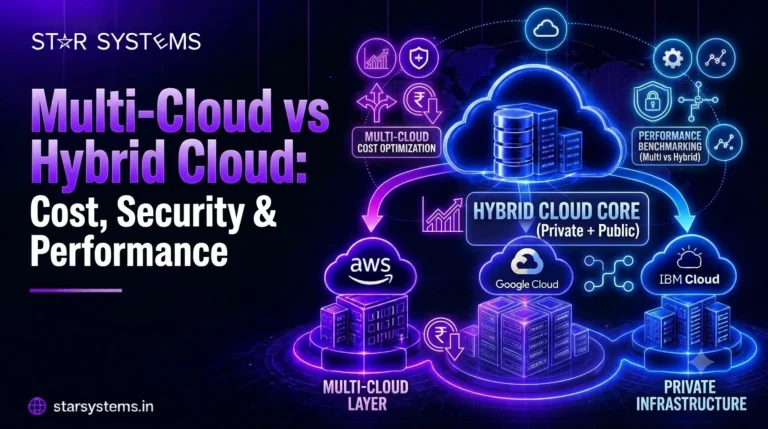
Multi-cloud is a strategy where a business uses cloud services from more than one public cloud provider, such as AWS, Azure, IBM Cloud, or Google Cloud. Each application runs where it fits best. For example, a company might host its Microsoft-based systems on Azure and its customer-facing apps on AWS.
What Is a Hybrid Cloud?
Hybrid cloud is a setup that combines private infrastructure, such as an on-premises data center or a private cloud, with a public cloud. The two environments are connected so data and applications can move between them. Businesses often choose hybrid clouds to keep sensitive systems close while using the public cloud for flexibility.
Multi-Cloud vs Hybrid Cloud at a Glance
Cost: Which Is Cheaper?
Hybrid cloud is often cheaper for steady workloads already running on owned hardware. Multi-cloud can save money through provider choice, but only with strong cost control.
Hybrid cloud lets you keep getting value from servers you have already paid for, while sending only flexible or growing workloads to the public cloud. The trade-off is that you still maintain hardware, power, and connectivity.
Multi-cloud gives you pricing leverage, because you can pick the best-value service for each job. But there are hidden costs: data transfer between providers, duplicate tools, and the skills needed to manage several platforms. Without clear monitoring, bills can grow quickly.
Security: Which Is Safer?
Neither is automatically safer. Hybrid cloud makes it easier to keep sensitive data tightly controlled, while multi-cloud security depends on applying the same rules everywhere.
In a hybrid setup, critical data can stay in an environment you fully control. The risk sits in the connections between private and public environments, which must be encrypted and carefully monitored.
In multi-cloud, each provider has its own identity system, settings, and security tools. The biggest danger is inconsistency, where one platform is configured strictly and another is not. Unified access policies and central monitoring are essential.
It depends on where your users and data are. Hybrid suits systems that need low latency to on-premises data. Multi-cloud helps place workloads closer to customers.
Hybrid cloud works well when applications must stay near existing databases or equipment, because there is no long trip over the internet. Multi-cloud can improve speed by running services in the regions or on the platforms that perform best for each user group. The weak spot in both is data movement. Moving large amounts of data between environments or providers adds delay and cost.
How to Decide: A Simple 4-Step Approach
- List your workloads. Note which ones handle sensitive data, which are old systems, and which need to scale quickly.
- Mark your limits. Write down compliance rules, budget, and the skills your team already has.
- Match each workload to a home. Sensitive or legacy systems may stay private, while flexible workloads move to the best-fit public cloud.
- Start small and test. Migrate one low-risk application first, measure cost and performance, then expand.
This approach keeps the decision practical. Instead of arguing about labels, you are choosing what works for each application, which is exactly how successful cloud strategies are built.
Common Mistakes to Avoid
- Adopting a multi cloud strategy just because it sounds modern, without a clear business reason.
- Ignoring data transfer fees when workloads talk to each other across providers.
- Leaving the connection between private and public environments unsecured.
- Using different security settings on each platform instead of one consistent standard.
- Skipping a pilot migration before moving critical applications.
A little planning here prevents the cost overruns and security gaps that catch most teams by surprise.
Can You Use Both?
Yes. Many organizations run a hybrid multi-cloud setup, with private infrastructure connected to several public clouds. It offers the most flexibility, but also the most complexity. A clear architecture, consistent security, and unified monitoring are what keep it manageable. For most businesses, the smart path is to grow into this model gradually, adding complexity only when the benefits are clear.
How Star Systems Helps With Multi-Cloud Migration
Moving workloads between clouds is where many projects stumble. Our Infra Bridge migration platform helps businesses move workloads from AWS, Azure, Google Cloud, IBM Cloud Classic, or on-premises environments into IBM Cloud VPC, with automated discovery and live progress tracking at every stage. It works alongside our wider cloud migration services, which cover assessment, planning, and post-migration support.
Key Takeaways
- Multi-cloud uses several public clouds. Hybrid cloud mixes private infrastructure with a public cloud.
- Hybrid is often better for control, compliance, and existing hardware.
- Multi-cloud is often better for flexibility and avoiding lock-in.
- Cost, security, and performance depend more on planning and governance than on the label.
- You can combine both in a hybrid multi-cloud model.
Not sure which approach fits your business? Talk to Star Systems for a free assessment and a clear migration roadmap.