What Is Multi-Cloud Database Migration?
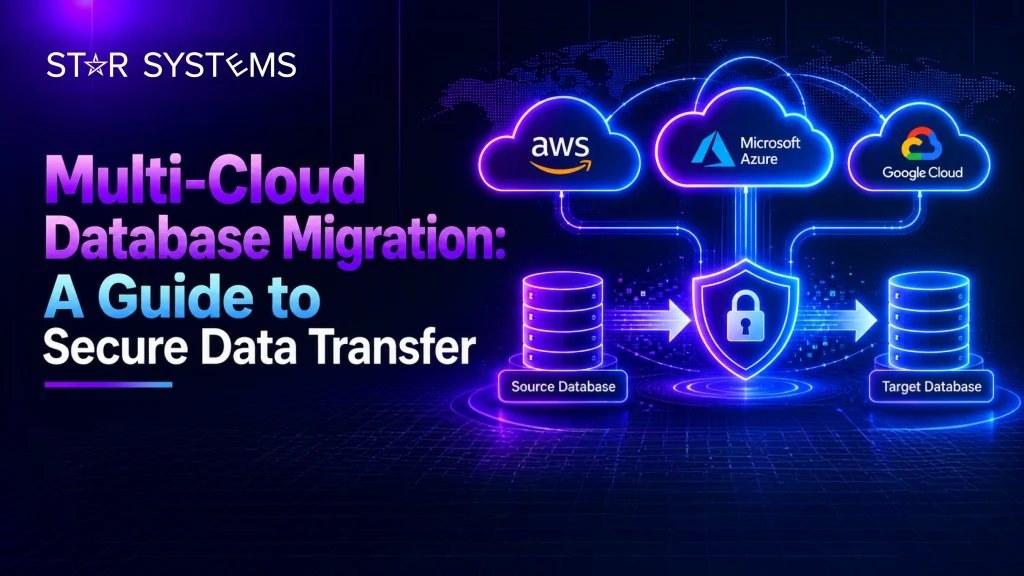
Multi-cloud database migration is the process of moving databases, records, and related data workloads between two or more cloud platforms. For example, a business may move a database from AWS to IBM Cloud or consolidate databases running across different environments into a centralized architecture.
Organizations consider this approach for several reasons:
- Improving database performance and availability
- Reducing dependency on a single cloud provider
- Supporting business expansion and new applications
- Meeting data security and compliance requirements
- Optimizing infrastructure costs
- Modernizing legacy database environments
However, every cloud platform has different storage systems, networking configurations, database services, and security controls. Understanding these differences before migration is essential for a smooth transition.
1. Assess Your Existing Database Environment
The first step is understanding what needs to be migrated. Businesses should identify their databases, data volumes, operating systems, application connections, and existing cloud resources.
A detailed assessment should include:
- Database type and version
- Data size and expected growth
- Application and service dependencies
- User access permissions
- Backup and recovery arrangements
- Network connectivity requirements
This assessment helps identify compatibility issues before the migration begins. It also helps teams decide whether a database should be moved as it is, upgraded, or redesigned for the target environment.
2. Choose the Right Multi-Cloud Migration Strategy
Not every database requires the same migration method. The right approach depends on application complexity, data volume, business priorities, and the capabilities of the destination platform.
Common migration approaches include:
- Lift and shift: Move the existing database environment to the target cloud with minimal changes. This can be suitable when the priority is infrastructure relocation.
- Replatforming: Make selected improvements to the database configuration or supporting infrastructure while moving it to the new platform.
- Refactoring: Redesign parts of the database or application architecture to take advantage of cloud-native capabilities.
A suitable migration strategy should balance cost, performance, security, and operational requirements instead of focusing only on moving data quickly.
3. Protect Data During Transfer
Security must remain a priority throughout database migration. Data may pass through different networks, storage systems, and cloud environments during the transfer process.
Businesses should use encrypted connections and secure transfer mechanisms to protect information in transit. Access to migration tools and cloud accounts should follow the principle of least privilege, giving each user or service only the permissions required to perform its task.
Additional safeguards include:
- Encrypting sensitive data during transfer and storage
- Using secure API credentials and access policies
- Restricting database access to approved networks
- Maintaining audit logs of migration activities
- Reviewing security configurations before and after migration
These controls reduce the risk of unauthorized access and help organizations maintain better visibility over their data.
4. Maintain Data Integrity with Validation
A database migration is successful only when the transferred data is accurate and usable. Even when a transfer process completes, businesses should not assume that every record has been migrated correctly.
Validation should be performed at multiple stages. Teams can compare record counts, table structures, database objects, checksums where appropriate, and application-level results between source and destination systems.
It is also important to test database queries, stored procedures, permissions, and integrations. For critical applications, business users should validate important workflows before the new database becomes the primary production environment.
5. Plan Database Downtime and Cutover Carefully
Database migration can affect applications that depend on continuous access to business information. A sudden change in database availability may interrupt customer transactions, internal operations, or reporting systems.
To reduce disruption, businesses can use phased migration, replication, or change-data-capture techniques where supported by the source and target databases.
A typical cutover plan includes:
- Taking a verified backup of the source database.
- Transferring the initial data to the target environment.
- Synchronizing changes made during the transfer period.
- Testing application connectivity and database performance.
- Scheduling the final switch to the destination database.
- Monitoring the new environment after cutover.
A rollback plan should also be prepared in case validation reveals a critical issue. The exact downtime depends on the database technology, data volume, network capacity, and migration method.
6. Consider Kubernetes Migration for Containerized Applications
Some businesses run database-connected applications inside containers. In these environments, Kubernetes migration may be part of a wider cloud modernization project.
Moving Kubernetes clusters between cloud platforms involves more than copying application containers. Teams must consider persistent storage, secrets, networking, service configurations, access permissions, and deployment pipelines.
Database connectivity must also be tested after the application workloads move. For stateful applications, persistent volumes and backup strategies need special attention.
Separating application migration from database migration where practical can make testing and troubleshooting easier. The two workstreams should still follow a coordinated plan to avoid compatibility or connectivity problems.
7. Plan IBM Cloud Classic to VPC Migration
Organizations using IBM Cloud Classic Infrastructure may also consider Classic to VPC migration as part of their infrastructure modernization strategy.
IBM Cloud VPC provides a software-defined networking environment with configurable subnets, security groups, and network access control lists. Moving workloads from Classic to VPC therefore requires careful planning of network architecture, storage, access policies, and application dependencies.
Database workloads need particular attention. Teams should verify database compatibility, storage requirements, connectivity, backup availability, and application configuration before moving production data.
A structured migration process helps businesses transition infrastructure while keeping database security and application functionality in focus.
8. Monitor and Manage the Cloud Environment After Migration
Migration does not end when the database becomes operational in its new environment. Businesses need continuous visibility into database performance, storage usage, network activity, security events, and resource consumption.
Effective Cloud Infrastructure Management helps organizations maintain stable operations after migration. Regular monitoring can identify unusual activity, resource constraints, and performance issues before they affect users.
Businesses should also review backup schedules, recovery procedures, access permissions, and cloud spending. These activities help maintain a reliable environment as data volumes and workloads grow.
How Star Systems Supports Secure Cloud Migration
A successful database migration requires technical planning, cloud platform knowledge, and careful execution. Star Systems provides cloud migration services to help businesses move applications, infrastructure, and data across cloud environments.
Its Infra Bridge migration platform supports workload discovery and migration from IBM Cloud Classic, AWS, Azure, Google Cloud, and on-premises environments into IBM Cloud VPC. The platform supports automated discovery, data transfer workflows, infrastructure configuration, and migration progress visibility.
For organizations planning IBM Cloud modernization, Star Systems also supports Classic-to-VPC migration and cloud infrastructure solutions. The right migration approach is selected based on workload compatibility, business requirements, and the target architecture.
With suitable planning and ongoing Cloud Infrastructure Management, businesses can improve operational visibility, protect critical data, and build a cloud environment that supports long-term growth.
Conclusion
Multi-cloud database migration can help businesses modernize their IT environments, improve flexibility, and prepare for changing technology needs. However, secure data transfer requires a clear strategy, accurate assessment, strong security controls, thorough validation, and a carefully managed cutover.
Whether an organization is moving databases between cloud providers, planning Kubernetes migration, or transitioning from IBM Cloud Classic to VPC, every stage should be aligned with business continuity and data protection goals.
Working with experienced cloud migration specialists can make the process more structured and manageable. With the right migration strategy and ongoing infrastructure management, businesses can move forward with greater confidence.
Planning a multi-cloud database migration? Connect with Star Systems to discuss your cloud migration requirements and identify a suitable migration approach for your business.