Top 7 Common Cloud Migration Challenges Enterprises Face
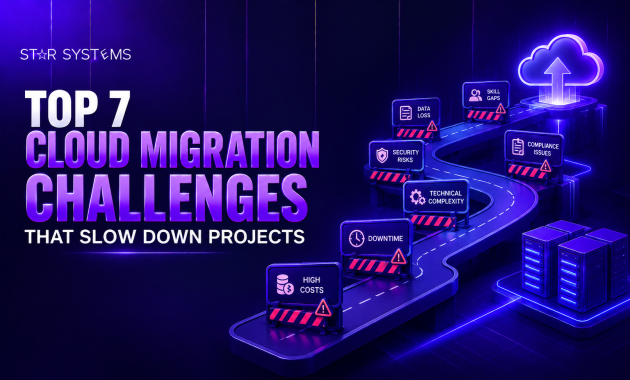
Most migration failures trace back to one of these seven recurring problems. Each needs a distinct fix, which is why serious providers treat them as separate engineering problems rather than one generic “lift and shift” task.
1. Legacy System Compatibility Challenges
Older virtualized or on-premises systems often run on outdated drivers, legacy OS images, or storage formats that don’t translate directly into modern cloud environments. Without proper image conversion and driver remediation, workloads frequently fail to boot once moved.
2. Dependency Blind Spots
Applications rarely run in isolation; most depend on other systems, databases, or services that aren’t documented anywhere. Migrating one workload without accounting for its dependencies can break connected systems the moment it moves. Manual dependency mapping using spreadsheets is slow and prone to human error.
3. Network and Architecture Re-Design
Moving from a traditional virtualized network to a software-defined cloud network means re-mapping IP addresses, DNS, and security group configurations. Constructs that worked in an on-prem environment often have no direct equivalent in the cloud. Skipping this step causes workloads to lose connectivity, or fail security review, immediately after migration.
4. Manual Rebuilds
Rebuilding servers manually in the new environment is time-consuming, error-prone, and expensive. Every manual rebuild risks losing configuration details, custom settings, or application dependencies. As-is, image-based migration approaches move workloads without recreating them from scratch.
5. Extended Downtime
Most business critical applications cannot tolerate long outages during migration. Without incremental synchronization, teams are forced to choose between long maintenance windows or risky one shot cutovers. Delta-sync technology copies only the data that changed since the last sync. This keeps cutover windows short, predictable, and far less disruptive to the business.
6. Configuration Drift
When migrations rely on one-off manual scripts, no two migration waves behave exactly the same way. Small inconsistencies between waves can snowball into major post-migration issues. Validated, repeatable migration processes ensure every wave follows the same tested steps. This consistency is what makes large-scale migrations predictable instead of chaotic.
7. Cost and Governance Overruns
Migrations without proper workload assessment often land on oversized, overpriced cloud infrastructure. This erases the cost savings that justified the move to the cloud in the first place. Assessment-driven right-sizing matches usage patterns to the correct instance size. Ongoing governance then keeps spending aligned with actual business needs.
Cloud Migration Services Handling Legacy System Compatibility Challenges
Legacy compatibility deserves a closer look, since it’s the challenge most likely to stall a migration on day one. Cloud migration services handle legacy system compatibility challenges through a structured process rather than a single quick fix. It starts with an assessment of source operating systems, drivers, and storage formats to flag compatibility risks before migration begins.
Automated tooling then converts VM images, injects the required drivers, and remediates OS-level settings so the workload boots cleanly in the target environment. Testing and validation follow immediately after, confirming the migrated system behaves exactly like its source before it’s handed back to production. This structured, tested approach is what separates a reliable migration provider from one relying on manual, ad hoc fixes.
How Managed Service Providers Address Hybrid Cloud Migration Challenges
Hybrid environments where some workloads stay on-prem and others move to the cloud add a layer of complexity that pure “cloud-only” playbooks don’t cover. Getting this right usually comes down to how well a provider sequences and automates the transition, rather than treating it as one big cutover event.
Data has to keep flowing between two environments that were never designed to operate as one system, security policies have to hold consistently across both sides, and the migration itself can stretch on for months while the business keeps running on the old and new environments at the same time.
Automated discovery: dependency mapping before anything moves, so interconnected systems migrate together in the right sequence.
Delta sync: replication-based tools that keep source and target environments aligned, shrinking cutover windows to minutes instead of hours.
Hybrid connectivity: a VPN or transit gateway layer so on-prem and cloud workloads can talk to each other throughout the transition, not just after it’s “done.”
Phased wave planning: lower-risk workloads migrate first to validate the process before mission-critical systems move.
Best Cloud Migration Services: Features, Benefits & Challenges Addressed
Every feature on this list exists to solve one specific problem from the challenges above and that problem, in turn, translates into a measurable business benefit. Read the table left to right: the feature is what the service does, the challenge column is the pain point it removes, and the benefit is what that means for your project.
|
Feature
|
What It Actually Does
|
Challenge It Solves
|
Business Benefit
|
|
Automated dependency discovery
|
Scans and maps how workloads connect before migration starts.
|
Dependency blind spots.
|
Fewer failed cutovers, faster planning.
|
|
Delta/incremental sync
|
Copies only what changed since the last sync, not the whole workload.
|
Extended downtime
|
Near-zero disruption cutover.
|
|
Agentless, image-based migration
|
Moves the workload as-is, no software installed on source machines.
|
Manual rebuilds
|
Lower service cost, faster timelines.
|
|
Encrypted in-transit replication
|
Encrypts data the moment it leaves the source environment.
|
Security exposure during transfer
|
Audit-ready, compliant transfers.
|
|
Assessment driven right sizing
|
Matches workload usage data to the correct target instance size.
|
Cost and governance overruns.
|
Predictable, optimized cloud spend.
|
|
Validated migration waves
|
Tests and repeats the same proven process for every batch.
|
Configuration drift
|
Consistent, repeatable outcomes.
|
Choosing Star Systems as the Partner Who Solves the Right Problems
Star Systems is a Cloud Migration Services Company built around solving exactly the seven challenges above, not around moving data and hoping the rest works itself out. Every engagement starts with dependency discovery and workload assessment, so migration waves are sequenced correctly before a single server moves.
Legacy compatibility issues are handled upfront through image conversion and driver remediation, rather than discovered mid-cutover. Delta-sync replication and validated, repeatable migration waves keep downtime short and every batch consistent, so the project stays on schedule and on budget from the first server to the last.
Talk to Team and get a straight answer on how each of these seven challenges would be handled on your migration before you sign anything.