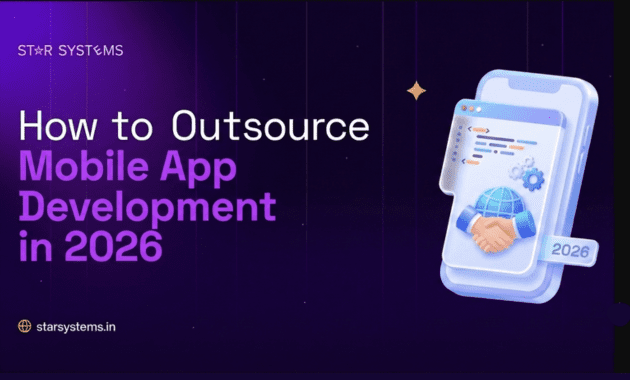
Building a competitive mobile app in 2026 demands UI/UX design expertise, cross-platform engineering, backend architecture knowledge, and ongoing DevOps support all working in sync. Assembling that in-house is expensive and slow. Outsourcing solves the equation but only when you know exactly how to do it.
This guide teaches you how to outsource mobile app development the right way in 2026.
What is Mobile App Development Outsourcing?
Mobile app development outsourcing is the practice of hiring an external team, a development agency, a Managed Service Provider, or specialist freelancers to design, build, test, and deploy a mobile application on behalf of your business.
Instead of recruiting and managing an internal engineering team, you delegate technical execution to a third-party partner. That partner may be in the same city, a different country, or distributed across multiple time zones. Your business retains ownership of the product, the intellectual property, and the strategic direction the external team handles the technical delivery.
Outsourcing is not the same as losing control. Modern outsourcing partnerships run on shared project management tools, sprint-based delivery cycles, and real-time communication channels, giving you full visibility at every stage.
Key Benefits of Mobile App Development Consulting
Risk Reduced Before Development Starts: The earlier problems are identified in the development lifecycle, the cheaper they are to fix. Consulting front-loads that discovery work and protects your budget before it is committed.
Objective Technical Assessment: An external consultant carries no internal politics or budget bias. They will tell you clearly whether your proposed feature set is too heavy for an MVP or whether your chosen tech stack will cause scaling problems in 12 months.
Accurate Cost Forecasting: Consultants who specialise in mobile development know what things genuinely cost across different geographies and tech stacks. Their estimates come from real project data, not internal guesswork.
Vendor Selection Guidance: A good consultant helps you evaluate and shortlist development agencies, saving weeks of research and protecting you from poor vendor choices.
Types of Mobile App Development Outsourcing
Understanding the outsourcing models available helps you choose the right structure for your project before you approach any vendor.
Offshore Outsourcing: Partnering with a development team in a geographically distant country, primarily for cost advantage. The most active destination markets in 2026 include India, Vietnam, Ukraine, and Poland.
Nearshore Outsourcing: Engaging a team in a nearby country within a compatible time zone.
Onshore Outsourcing: Hiring a domestic development agency. Higher cost, but simpler communication, shared legal frameworks, and natural cultural alignment.
Freelance Outsourcing: Contracting individual specialists through talent platforms. Cost-effective for small, clearly scoped tasks but rarely suited to complex, multi-phase product builds.
Hybrid Model: Combining an onshore project lead with an offshore development team. Balances communication quality with cost efficiency and works well for mid-to-large projects.
Step-by-Step Guide to Outsourcing Mobile App Development
Step 1: Before speaking to any vendor, document what your app must do, who the target users are, and which platforms you need (iOS, Android, or both).
Step 2: Know your numbers before entering vendor conversations. A standard app built by a mid-tier agency in 2026 typically ranges from $20,000 to $80,000. Complex apps with custom backends, third-party integrations, and advanced UI can exceed $200,000. Establish your range before any discussions begin.
Step 3: Study each vendor’s portfolio, specifically apps comparable in complexity to yours. Check independent review platforms. Request references from past clients in your industry. Bring three to five vendors through to detailed evaluation.
Step 4: Share your requirements document with shortlisted vendors and request a structured proposal. Evaluate not just price, but team composition, documented processes, and support terms.
Step 5: Interview the engineers who will actually work on your project not just the sales team. Ask about platform experience and how they handle mid-project scope changes.
Step 6: Before committing to full development, engage your selected vendor for a dedicated discovery phase, typically two to four weeks. This produces a detailed technical specification, system architecture plan, and a refined cost estimate.
Step 7: Agree in writing on how progress will be reported, how decisions will be escalated, and how scope changes will be handled contractually.
Step 8: Once development is underway, review deliverables at the close of every sprint. Give feedback quickly.
Step 9: Before app store submission, conduct structured testing with real users from your target audience.
Step 10: App store submission and performance monitoring must be covered in your agreement. Establish a maintenance retainer for ongoing bug fixes, OS update compatibility, and feature iterations.
Challenges of Outsourcing Mobile App Development:
Communication Gaps: Distributed teams across time zones and cultural contexts create space for misunderstandings to grow. Counter this by locking in overlapping work hours and documenting all key decisions in writing.
Inconsistent Code Quality: Not every vendor maintains uniform standards across a full project lifecycle. Require structured code reviews and include automated testing mandates in your contract from the start.
Intellectual Property Exposure: Your contract must explicitly assign full ownership of all code, designs, and digital assets to your business upon payment.
Hidden Costs: A low offshore hourly rate can mask high coordination overhead, unexpected charges for project management tools, and communication platforms.
Key Factors to Consider Before Outsourcing Mobile App Development
Clarify IP Ownership from the Start: Who owns the code? Who owns the design files? Who controls the app store developer account? Every question must have a written, contractual answer before any work begins.
Evaluate Communication Infrastructure: Technical excellence without reliable communication produces failed projects.
Audit Security and Data Practices: If your app handles user data, verify the vendor operates under adequate data protection policies, uses encrypted repositories, and complies with applicable regulations.
Confirm Launch Support Terms: App is not complete at launch day. Your contract should include a defined warranty period and a clear handover process if you ever choose to bring development in-house. </p.
Check Technology Stack Alignment: The frameworks and tools your vendor works with must align with your long-term product roadmap.
Outsourcing vs. In-House App Development
| Factor |
Outsourcing |
In-House |
| Cost |
Lower total cost for project-based builds. |
High fixed cost: salaries, benefits, tools. |
| Speed to Start |
Days to weeks |
Months of recruiting and onboarding |
| Control |
Strong with proper governance frameworks |
Full, real-time visibility and control. |
| Expertise Breadth |
High access to multi-disciplinary teams. |
Limited by who you can hire and retain. |
| Scalability |
Flexible scale by phase and need. |
Slow and HR-intensive to adjust. |
| Long-Term Evolution |
Depends on chosen engagement model. |
Stronger for deeply integrated products. |
| Domain Knowledge |
Requires onboarding and documentation. |
Builds naturally over time. |
Conclusion
Knowing how to Outsource Mobile App Development in 2026 is not just a procurement skill; it is a strategic business capability. When the process is executed well, it compresses development timelines, delivers expert-grade technical execution, and gives your leadership team the focus needed to drive real business growth.