This matters because enterprises can’t pick just one environment anymore. Pure cloud AI is fast but raises data control and compliance questions. Pure on-premises AI is secure but can’t match cloud-scale GPU access. Hybrid cloud AI is the architecture built specifically to remove that trade-off.
What Is Hybrid Cloud?
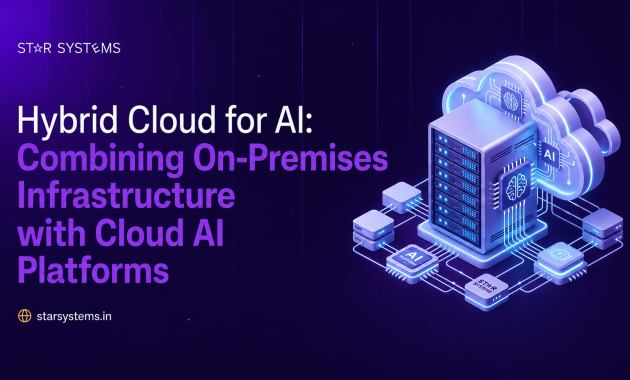
Hybrid cloud is an IT infrastructure model that combines private, on-premises servers with public cloud services, connected so they work as one system instead of two separate ones. Data and applications can move between the two environments based on cost, performance, or compliance needs, instead of being locked into a single location.
This is different from multi-cloud, which means using several public cloud providers together without any private infrastructure involved. Hybrid cloud is specifically about combining private infrastructure with public cloud one environment for control, one for scale.
When this model is applied to AI workloads specifically, it’s called hybrid cloud AI. A bank’s transaction data stays on private servers, while the fraud-detection model trained on that data runs in the public cloud using cloud GPUs. The raw data never leaves the bank’s own network; only the model and its outputs use cloud resources.
Why Enterprises are Moving to Hybrid Cloud AI
Three forces are pushing enterprises toward hybrid cloud AI: regulation, compute cost, and infrastructure limits. Each one on its own would justify the shift. Together, they make hybrid cloud the default choice for any serious enterprise AI program.
Regulation and data sovereignty: Healthcare, banking, government, and manufacturing all operate under data residency rules HIPAA for patient data, PCI-DSS for payment data, GDPR for EU citizen data. None of these laws say “you can’t use AI.” They say sensitive data must stay within defined boundaries. Hybrid cloud AI satisfies this by keeping regulated data on-premises while still using cloud AI tools for processing and analysis.
Compute cost and access: Training a modern AI model needs high-performance GPUs that most enterprises don’t own and shouldn’t buy outright, since GPU hardware depreciates fast and demand is inconsistent. Cloud AI platforms rent this compute by the hour. An enterprise can train a model for a week, then release that capacity, paying only for what it used.
Infrastructure limits: Legacy on-premises systems often can’t run modern AI workloads at scale even if a company wanted them to. Building that capacity in-house takes years and large capital spend. Hybrid cloud AI lets companies keep their existing infrastructure for what it already does well, and offload only the AI-specific compute to the cloud.
The 4-Layer Hybrid AI Architecture
A working hybrid AI setup is built on four layers. Each layer has one job. Most hybrid AI failures trace back to one of these layers being skipped or poorly connected to the others.
1. Data Layer: This is where customer records, transaction logs, operational data, and IoT data live. Sensitive datasets stay on-premises. Non-sensitive or anonymized data can be copied to the cloud for processing without compliance risk.
2. AI Development Layer: Data scientists build and train models here, using cloud-native platforms for the compute-heavy parts: training runs, fine-tuning, testing predictive algorithms. The cloud’s elastic scale makes this layer far faster than relying on fixed on-premises GPU clusters.
3. AI Operations Layer: Once a model is trained, it gets deployed wherever it performs best. Low-latency applications run on-premises. Real-time use cases run at edge locations. Large-scale analytics run in the public cloud. This layer is about placement, not just deployment.
4. Security and Governance Layer: This layer runs through all three others, not above them. It covers Identity and Access Management (IAM), Zero Trust access controls, encryption at rest and in transit, threat detection, and AI-specific governance model auditing, bias checks, and usage monitoring.
Key Benefits of Hybrid Cloud AI
Enhanced security: Sensitive data stays inside infrastructure the organization directly controls, instead of being exposed across a third-party network it doesn’t manage. Cloud AI tools still get used, but only on the data cleared to leave the building.
Improved performance: Workloads run where they’re fastest — latency-sensitive applications stay close to users on-premises or at the edge, while heavy analytics jobs that need raw compute power run in the cloud.
Regulatory compliance: Data residency requirements get met by default, since regulated data never leaves its approved environment. This removes one of the biggest blockers enterprises face when starting AI projects.
Business continuity: Workloads can shift between environments during outages, maintenance, or disaster recovery scenarios, so AI operations don’t go down because one environment failed.
Faster AI adoption: Teams stop waiting on infrastructure approvals or hardware procurement cycles. Cloud capacity is available immediately, while sensitive workflows continue running on existing systems.
Hybrid Cloud AI in Action by Industry
Healthcare: Patient records stay on-premises to satisfy HIPAA, while cloud AI platforms power diagnostics support, medical imaging analysis, and predictive readmission models. The hospital keeps the records; the cloud provides the processing power to act on them faster.
Banking and Financial Services: Fraud detection models run in the cloud to catch patterns across millions of transactions in real time, while the underlying customer and account data stays inside the bank’s own controlled environment, never replicated outside it.
Manufacturing: Plant-floor operational data is processed locally for split-second decisions on machinery and safety, while cloud AI handles the heavier analytical work: supply chain optimization, predictive maintenance scheduling, and quality assurance across multiple facilities at once.
Government: Citizen-facing services get modernized with AI-driven automation and chat-based support in the cloud, while citizen records and identity data stay on-premises to meet data sovereignty laws.
Hybrid Cloud AI vs. Public Cloud AI vs. On-Premises AI
| Factor |
On-Premises AI |
Public Cloud AI |
Hybrid Cloud AI |
| Data control |
Full |
Limited |
Full for sensitive data |
| Scalability |
Limited, capital-heavy |
High, elastic |
High, selective |
| Compliance fit |
Strong |
Variable |
Strong |
| Cost model |
High upfront |
Pay as you go |
Optimized mix |
| Best for |
Regulated, latency-critical data |
Rapid experimentation, training |
Enterprises needing both |
Future of Enterprise AI Is Hybrid
Enterprise AI is no longer a choice between cloud or on-premises. It’s a decision about which workload belongs where, and how securely both environments connect. The organizations getting real results from AI right now are the ones that treated this as an architecture problem first, not a vendor selection problem.
End Note:
At Star Systems, a leading Cloud Consulting Services design, deploy, and secure hybrid cloud AI environments for enterprises that need both control and scale. Our work spans hybrid architecture design, cloud security, identity and access management, and AI governance built so organizations can run AI on their terms, not their provider’s.