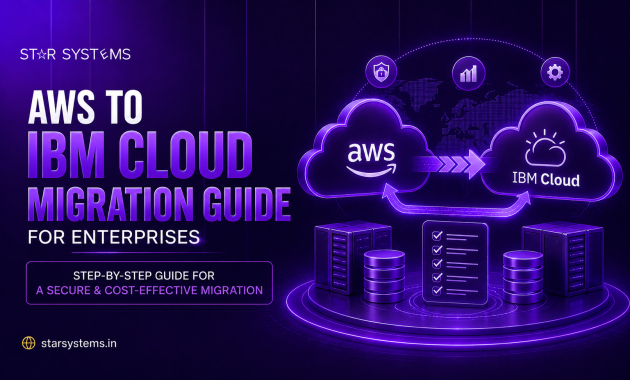
As organizations continue to review their cloud strategies, businesses running workloads on Amazon Web Services (AWS) are increasingly evaluating whether IBM Cloud could better support specific enterprise requirements. This has created growing interest in AWS to IBM Cloud migration as part of broader cloud transformation initiatives.
However, moving workloads between two different cloud platforms is not a straightforward copy-and-paste exercise. AWS and IBM Cloud have different infrastructure architectures, networking models, security configurations, storage technologies, and service capabilities. A successful migration therefore requires careful planning before the first workload is moved.
Why Are Enterprises Considering AWS to IBM Cloud Migration?
AWS has become a major component of enterprise IT infrastructure. Over time, however, cloud environments have become more complex.
Many organizations now operate a combination of public cloud, private infrastructure, on-premises systems, SaaS platforms, databases, and business-critical applications.
As these environments grow, IT leaders are asking more strategic questions. Is the current infrastructure still aligned with business requirements? Are cloud resources being used efficiently? Can critical workloads be managed more effectively? Does the existing environment support the organization’s hybrid-cloud strategy? Can infrastructure be better aligned with security and compliance requirements?
These questions can lead organizations to evaluate alternative cloud environments, including IBM Cloud. For businesses already working with IBM technologies or developing a hybrid-cloud strategy, IBM Cloud can become an important option when evaluating where specific enterprise workloads should operate.
1. AWS to IBM Cloud Migration Is Not Just a Lift-and-Shift
The term “lift-and-shift” is often used when discussing cloud migration. In practice, enterprise migration is usually more complicated. An AWS environment can contain EC2 instances, EBS volumes, VPCs, security groups, IAM policies, load balancers, databases, storage, Kubernetes environments, monitoring systems, and application integrations, and each of these components can have dependencies on other parts of the infrastructure.
2. The Importance of AWS Workload Assessment
Every workload does not need to follow the same migration path. A proper assessment should examine the application’s infrastructure, data, dependencies, performance requirements, security controls, availability requirements, and business importance to determine whether a workload should be rehosted, replatformed, refactored, retained, or retired.
3. Mapping AWS Workloads to IBM Cloud
AWS services should not always be mapped to IBM Cloud based simply on similar product names. The target architecture needs to be designed around the workload’s compute, storage, networking, security, availability, scalability, and monitoring requirements.
4. Data Migration Requires Careful Planning
Large databases and storage environments cannot simply be transferred without considering data integrity, security, synchronization, bandwidth, recovery, and downtime. This makes data migration planning an essential part of the overall cloud migration strategy.
5. Network and Security Considerations
Existing AWS environments may have complex relationships between virtual networks, subnets, routing, firewalls, VPN connections, load balancers, applications, and external systems, and these relationships need to be understood before designing the IBM Cloud environment.
6. Why a Phased Migration Approach Makes Sense
A phased approach allows organizations to begin with selected workloads, validate the migration process, identify technical challenges, and improve the methodology before moving more critical applications in planned waves.
7. Migration Can Also Be an Opportunity for Modernization
Migration provides an opportunity to ask whether existing applications and infrastructure are still designed for current business needs. Some workloads may benefit from modernization before migration, while others may require only limited changes.
8. What Should Businesses Evaluate Before Migration?
Before starting an AWS to IBM Cloud migration, organizations should evaluate current infrastructure, application dependencies, business criticality, security and compliance needs, data requirements, target architecture, and the right migration strategy for each workload.
How Star Systems Supports AWS to IBM Cloud Migration
At Star Systems, we approach cloud migration as a structured transformation journey. Our focus is on understanding the existing environment first, identifying workload dependencies, defining the target architecture, and developing a migration roadmap that aligns with business priorities.
Our approach can support organizations across AWS environment assessment, workload discovery, migration readiness analysis, architecture planning, infrastructure migration, application and data migration, testing, production cutover, and post-migration optimization.
Rather than assuming that every workload should be moved in the same way, our approach is based on the specific requirements of each application and business environment, helping organizations make informed migration decisions while reducing unnecessary disruption to their operations.
When Should an Organization Consider AWS to IBM Cloud Migration?
There is no single reason for an organization to consider moving from AWS to IBM Cloud. For some businesses, the decision may be driven by a broader hybrid-cloud strategy. For others, it may involve enterprise application requirements, infrastructure optimization, security and compliance considerations, or alignment with an existing IBM technology ecosystem.
In many cases, organizations do not need to move everything. The better approach is to identify the workloads where migration can provide meaningful business and technical value.
Final Thoughts
AWS to IBM Cloud migration is more than a change in infrastructure. Done correctly, it can become an opportunity to reassess workloads, modernize applications, improve cloud architecture, strengthen security, and create a more strategic technology environment.
The success of the migration depends largely on what happens before the migration begins. Understanding the existing AWS environment, identifying dependencies, selecting the right migration strategy, designing the IBM Cloud architecture, and planning the transition carefully can significantly reduce migration risks.
Star Systems helps enterprises evaluate their existing cloud environments, develop migration strategies, and execute structured cloud transformation initiatives. Reach out to our team to start your AWS to IBM Cloud migration assessment today.