What Is DevSecOps?
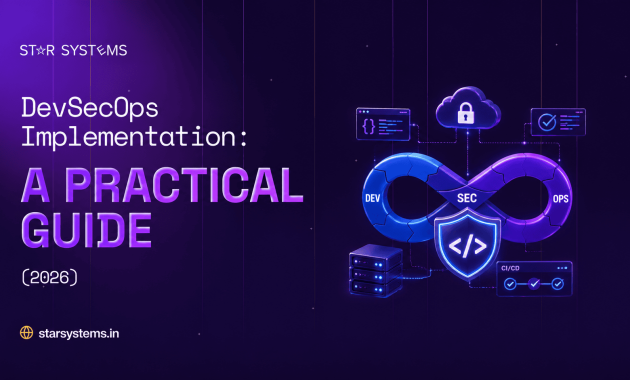
The DevSecOps approach builds on DevOps by integrating security tests into the CI/CD pipeline. This means that instead of doing security tests as an additional step after development, security tests are done as an integral part of the process every time you commit, build, or deploy your code. The purpose is obviously to identify vulnerabilities as soon as possible.
Why DevSecOps Matters in 2026
The attack surface has increased due to microservices, containers, and multi-cloud deployments. The regulatory pressure on SOC 2, ISO 27001, and GDPR is also increasing. There is no way manual security testing can cope with weekly or daily deployments. Companies that automate security tests release software quickly without any chances of breaches and audit failures.
Core Principles of DevSecOps
A real DevSecOps culture rests on a few non-negotiable principles:
Shift-left security: Vulnerabilities are caught at the code-writing stage instead of after deployment. This reduces fix costs dramatically, since patching an issue in production is far more expensive than catching it in a pull request.
Automation over manual gates: Security scans trigger automatically with every commit and build, removing the need for a human reviewer to approve each step. This keeps release velocity high while still enforcing consistent security standards.
Shared ownership: Developers, security engineers, and operations teams all share responsibility for secure code. No single team is left holding the blame when something slips through, which encourages collaboration instead of finger-pointing.
Continuous monitoring: Production environments are watched in real time using automated alerts and dashboards, not reviewed periodically through scheduled audits. This allows teams to detect and respond to threats within minutes rather than weeks.
Compliance as code: Regulatory and internal policies are written as machine-readable rules that pipelines enforce automatically. This removes the guesswork and manual paperwork typically associated with audits and certifications.
DevSecOps Implementation Roadmap
Step 1: Assess Current Maturity – Audit existing pipelines, tooling, and team skill gaps before adding new processes.
Step 2: Define Security Policies as Code – Convert compliance requirements into machine-readable policies enforced through your pipeline.
Step 3: Integrate Static and Dynamic Scanning – Add SAST (static analysis) at the code stage and DAST (dynamic analysis) at the staging/testing stage.
Step 4: Automate Dependency and Container Scanning – Scan open-source libraries and container images for known CVEs before they reach production.
Step 5: Manage Secrets Properly – Replace hardcoded credentials with a dedicated secrets manager and automated rotation.
Step 6: Implement Infrastructure as Code (IaC) Scanning – Validate Terraform, CloudFormation, or Kubernetes manifests for misconfigurations before deployment.
Step 7: Set Up Continuous Monitoring and Alerting – Deploy runtime security tools that detect anomalies and trigger automated responses.
Step 8: Train Teams Continuously – Run regular security workshops so developers write secure code by default, not by exception.
Security Practices Across the Pipeline
| Pipeline Stage | Security Activity & Impact |
|---|
| Plan | Threat Modeling: Anticipate where attackers may try to breach the system and design preemptive measures. |
| Code | Pre-commit Hooks: Detect secrets and vulnerable code immediately within the IDE before repository commits. |
| Build | SAST & Dependency Scans: Executed on each pull request to block unsafe code from merging. |
| Test | DAST & Penetration Testing: Test application resilience against live attack vectors to find runtime issues. |
| Release | Policy Gates & Signed Artifacts: Prevent deployment of any build that hasn’t successfully cleared verification. |
| Deploy | IaC Scanning: Catch misconfigurations (like open ports or public storage) before provisioning resources. |
| Operate | Runtime Protection: Detect, isolate, and block active live threats in production automatically. |
| Monitor | Feedback Loops: Feed application logs and real-time metrics back into the next planning cycle. |
Common Challenges and How to Overcome Them
Tool sprawl: Too many disconnected scanners create alert fatigue. Consolidate into a unified security dashboard.
Developer resistance: Developers consider security an inhibitor. Address it with rapid feedback loops and good documentation, not rules.
Alert fatigue: The influx of low-severity alerts makes developers ignore real vulnerabilities. Severity and exploitability should determine priority.
Knowledge scarcity: Security skills are hard to come by. Instead of trying to have everything centralized, use security champions.
Why Choose Star Systems for DevSecOps Consulting?
Transitioning to a mature DevSecOps model requires shifting cultures, modifying legacy pipelines, and avoiding tool fatigue. As a premier DevSecOps Consulting Services firm, Star Systems bridges the gap between velocity and security:
Structured CI/CD Integration: We don’t believe in one-size-fits-all. We architect security automation seamlessly into your existing Git, Jenkins, GitLab, or cloud-native pipelines without slowing down development sprints.
End-to-End Compliance Automation: We transform complex frameworks like SOC 2, ISO 27001, and GDPR into machine-readable “Compliance as Code,” making audit compliance automated and painless.
Practical Hybrid & Multi-Cloud Expertise: From container security (Docker/Kubernetes) to complex cloud environments (AWS, Azure, IBM Cloud, GCP), we secure your entire architecture.
Fostering Security Culture: We don’t just hand over tools; we train your existing development teams to become internal security champions, reducing technical friction from day one.
Conclusion
Adoption of DevSecOps is not an initiative that takes place one time, but rather a journey of continuously moving from conventional development to development that emphasizes building, testing, and releasing applications differently. Successes of 2026 will be the companies that have implemented automation in their security initiatives, measuring the outcomes, and treating security as a part of the code.
Secure software delivery starts with the right strategy. Star Systems’ DevSecOps Consulting Services help organizations integrate security into every phase of the development lifecycle, enabling faster releases, reduced risk, and continuous compliance across modern cloud-native environments.